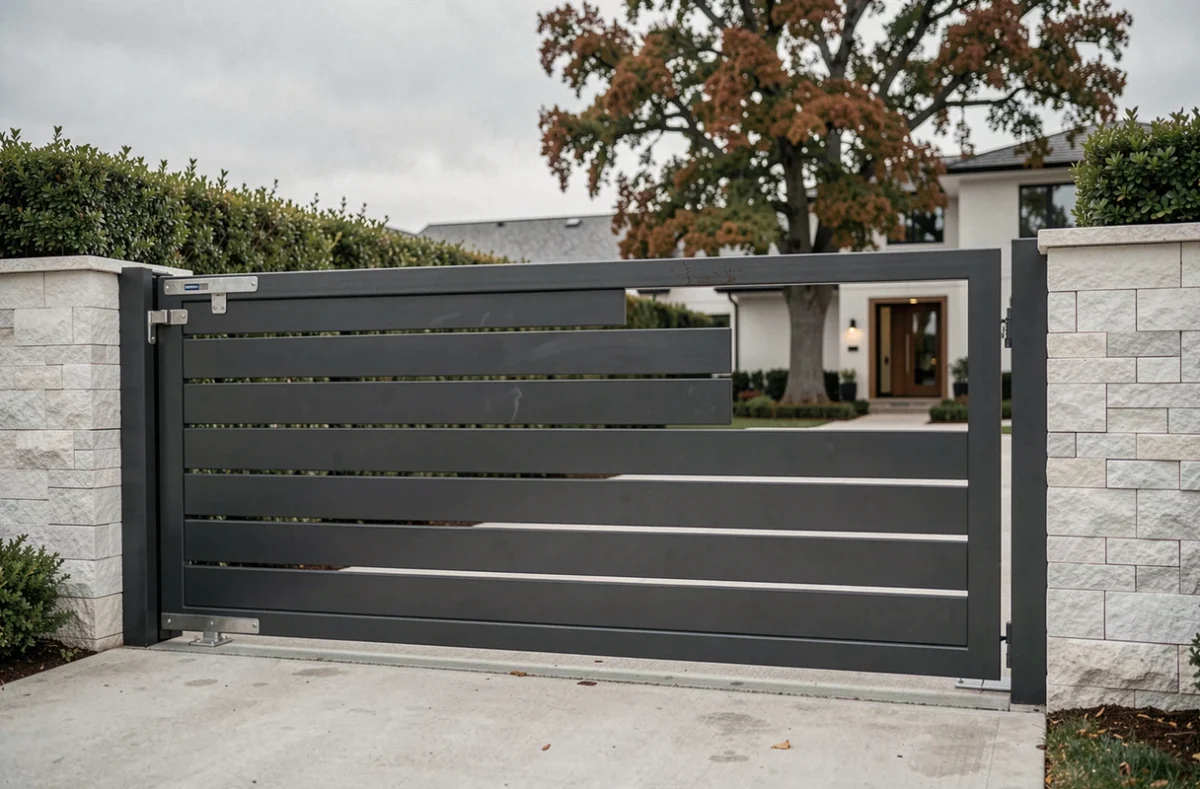
Sliding or swing gate: the choice rarely comes down to a single factor. Available space, ground slope, frequency of use, local regulations and what happens in the event of a breakdown all contribute to a set of criteria that carry different weight depending on the configuration. Comparing these two systems point by point helps identify the differences that really matter before installation begins.
Sliding or swing gate: a comparison table of technical constraints
| Criterion | Swing gate | Sliding gate |
|---|---|---|
| Ground space required when opening | Arc-shaped swing area (inward or outward) | Lateral clearance along the fence |
| Sloping ground | Risk of the gate leaves scraping the ground | Suitable if the track or guide follows the slope |
| Clear opening width | Limited by the size of each gate leaf | Single panel, full-width opening |
| Manual opening during a power outage | Simple release of the arms or rams | Heavy panel to push along the track, requiring more effort |
| Routine maintenance | Lubricating the hinges, checking alignment | Cleaning the track (debris, ice), lubricating the guide |
| Wind sensitivity | Gate leaves catch a lot of wind when open | Surface parallel to the fence, reduced wind exposure |
This table summarizes the basic mechanical differences. Before making a decision, these constraints need to be weighed against how the gate will actually be used and the property’s regulatory context.
Before installation, it is worth choosing between a sliding or swing gate based on the specific layout of the property and the existing pillars.
Power outages and accessibility: the factor few quotes cover in detail

A motorized gate that breaks down does not cause the same problems with both opening systems. With a swing gate, releasing the arms or rams makes it possible to push the leaves open by hand with moderate effort. With a sliding gate, the single panel is often much heavier, and moving a sliding gate manually requires considerably more effort than opening a released swing gate.
This difference takes on added importance for people with reduced mobility. In multi-unit housing, accessibility requirements cover the clear opening width, opening force and height of the controls. These rules, which apply to new builds and certain modified entrances in existing buildings, sometimes mean separating the pedestrian gate from the vehicle gate.
For a busy shared entrance (residential complex, condominium, shared parking lot), a sliding gate has a clear advantage: it takes up no space in front of or behind the opening, allowing successive users to pass through more easily. A swing gate, by contrast, temporarily blocks an arc-shaped area during each opening cycle. Where traffic is heavy, this can slow the flow and increase the risk of a collision with a pedestrian or vehicle.
Local regulations and zoning plans: swing gates opening onto public roads
Gates are generally subject to the same rules as fences. Depending on the municipality and the property’s location, prior planning permission may be required, even for a straightforward replacement. The local zoning plan may set a maximum height, specify the exterior appearance or require a setback from the road.
A swing gate that opens outward raises a specific issue. If the leaves extend over the pavement or public road, a permit to occupy public land may be required. In practice, many property owners are unaware of this, which can result in the municipality requiring them to bring the installation into compliance.
- Check the municipality’s local zoning plan before choosing which way the swing gate will open
- Ask whether the area is covered by a protected-zone designation (ABF, historic monument) that imposes material or color restrictions
- For a sliding gate, make sure the lateral clearance does not extend onto a neighboring property or shared accessway
A sliding gate avoids the issue of extending onto a public road, which often makes it easier to get approved in densely populated urban areas.
Maintenance and common breakdowns: frozen tracks versus seized hinges

The two systems break down for different reasons. A sliding gate on a track can be affected by debris building up in the track or ice forming in winter. Swing gates are more likely to scrape against ground that has shifted or to have hinges seize due to corrosion.
When a motorized gate closes and then opens again on its own, the first instinct is to suspect the motor. The cause is more often mechanical: safety sensors detect abnormal resistance and reverse the gate’s movement. Disabling these safety features to force the gate closed is a mistake that could cause a crushing injury or damage the motor.
- For a sliding gate, clean the track at least twice a year and check the condition of the guide roller
- For a swing gate, lubricate the hinges and check the pillars’ alignment every year
- For both types, have a professional check the photoelectric sensors and force settings if the gate struggles or moves abnormally
In terms of long-term maintenance costs, a sliding gate requires more regular attention at ground level, while a swing gate puts more strain on its fixing points and pillars.
Gates and materials: the type of gate affects the options available
Wood, aluminum, steel and PVC are available for both configurations, but the panel’s weight makes a difference. A wide, solid-wood sliding gate is heavy and requires a powerful motor, increasing the overall cost. Aluminum remains the most versatile material for a motorized sliding gate thanks to its balance of light weight and rigidity.
For a swing gate, wood remains a strong aesthetic choice, especially in areas where the local zoning plan requires a traditional appearance. It needs more frequent maintenance (staining, treatment) than aluminum, but replacing a damaged gate leaf costs less than replacing an entire sliding panel.
The factor that really determines which of these two gate types is right for you depends on the property’s layout and day-to-day use. A narrow, sloping entrance points to a sliding gate. On flat ground with plenty of space in front of the entrance, either option will work, and the deciding factors will then be how the gate performs during a breakdown and local regulations.