
Evening homework concentrates two types of fatigue: that of the child after their school day, and that of the parent after their workday. This overlap explains the majority of tensions. Helping your children with their homework without stress requires more organization than willpower: a few concrete adjustments to the rhythm, posture, and environment are enough to reduce conflicts.
When homework triggers a persistent conflict: what to check first
You may have noticed that some evenings go well, while others turn into a tug-of-war for no apparent reason? Before looking for motivation tips, one preliminary step deserves your attention: check if the problem really stems from motivation.
A child who systematically resists homework, struggles to concentrate despite an appropriate environment, or bursts into tears over a reading exercise may signal an undetected learning difficulty. In this case, increasing reminders or extending work time worsens the situation.
First, discuss it with the teacher. If difficulties persist and affect daily life (disrupted sleep, recurring anxiety, school refusal), an assessment by a health professional (speech therapist, school psychologist) can help establish an appropriate framework. Knowing how to do homework without getting upset on Cap Famille also involves this clarity: sometimes the lever is not educational, it is medical.
Another often overlooked point: the actual workload assigned by the teacher. In primary school, written homework is not mandatory. If your child spends more than twenty minutes on an exercise meant to be quick, ask for clarification from the school. It sometimes happens that a parent turns a light review into an intensive revision session, without it being expected.

Screens and fatigue before homework: a sequence to observe
We often talk about the workspace (calm, tidy, well-lit), but rarely about what happens in the minutes leading up to homework. If your child spends time on a tablet or phone just before sitting at their desk, the transition to a focused effort becomes more difficult.
This is not about demonizing screens. The mechanism is simple: a screen demands attention passively and quickly, while homework requires voluntary and slow effort. The brain takes time to switch modes.
Observe what happens at your home over a week. If the child uses a screen and then dives into homework, try to intersperse a few minutes of transition:
- A short physical moment (walking the dog, tidying their room, simply walking to the kitchen for a glass of water)
- A verbal exchange about their day, which shifts the brain back to active mode
- Preparing the work materials, which serves as a gentle transition to concentration
This transition does not need to last long. Its role is to cut the flow of rapid stimulation to prepare for sustained effort.
Homework done at middle school: moving work outside the home
When tensions around homework become chronic, one option remains underutilized: the “Homework Done” program offered in middle schools. This program allows students to complete their personal work at the school, supervised by teachers or educational assistants.
The advantage is twofold. The child works in a school setting, with a supervisor who is not their parent. And the parent picks up a child who has already finished their homework, eliminating the main source of evening conflict.
When to consider this option
If you notice that homework generates shouting or crying several evenings a week, the problem may not be your method. It might be the location. Separating the role of parent and that of tutor protects the relationship.
Inquire at your child’s middle school about available time slots. The program is free and open to all middle school students, regardless of income or academic performance.
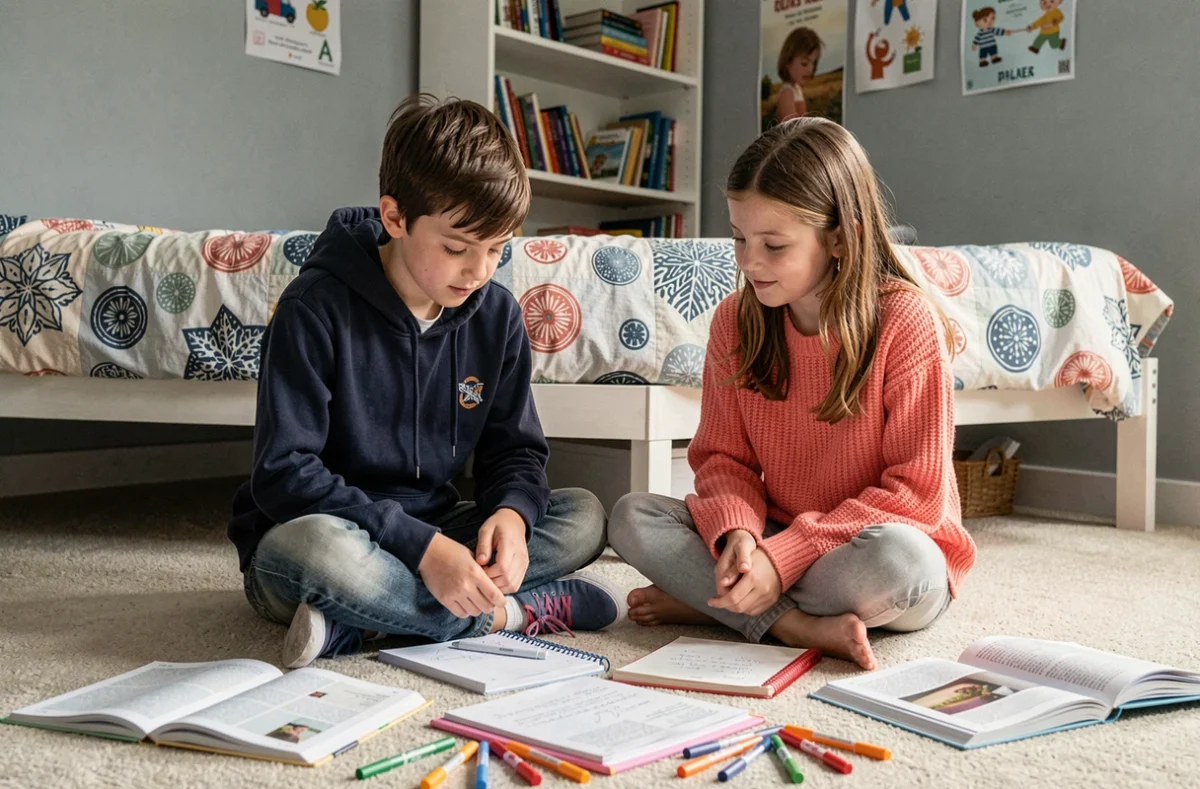
Supporting homework without doing the work for the child
You are sitting next to your child, who is stuck on a math problem. The urge to give them the answer is strong, especially when time is tight. But giving the solution deprives the child of the process that builds their memory.
A more effective approach is to ask intermediate questions. Instead of saying “the answer is 42,” try “what did you understand from the statement?” or “what calculation would you do first?”. The child engages their thinking, even if they need several attempts.
When the child really doesn’t understand
Sometimes, despite the questions, the child remains stuck. In this case, there’s no point in insisting. Note the exercise, inform the teacher of the difficulty, and move on. Forcing a child to finish an exercise they don’t understand produces no learning. It creates frustration.
A practical guideline: if an exercise takes more than double the expected time, it’s a signal to stop. It’s better to have an unfinished assignment accompanied by a note to the teacher than an evening of tears for a rushed result under pressure.
- For lessons to memorize: ask the child to explain the lesson in their own words, rather than rereading the text repeatedly
- For exercises: let the child make mistakes, then guide them towards their own correction
- For reading: alternate a page read by the child and a page read by you, to maintain enjoyment without the effort becoming overwhelming
The homework time is not meant to catch up on gaps accumulated over a term. It is a short time for consolidation. When it exceeds this framework, the solution is often found elsewhere: at school, with a professional, or simply by accepting to let go one evening out of two. Preserving the relationship with your child is worth more than a completed exercise.